Beyond Physiology
Understanding Climbing's "Capacity vs. Execution" Puzzle Through Ecological Hierarchy and Motor Control (Article 2 of the "New Framework" Series)

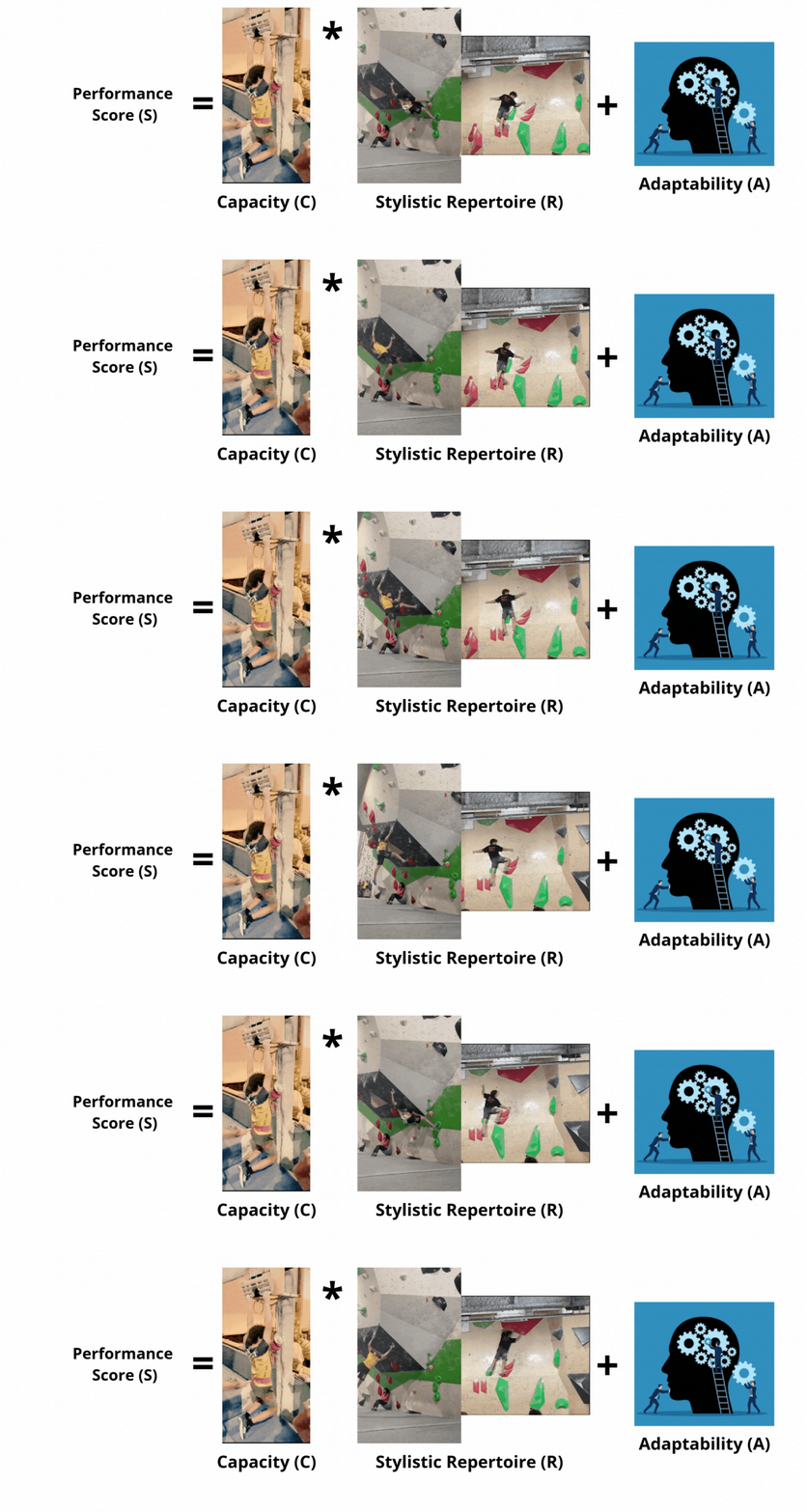
Abstract: The Transferability Challenge
The research community consistently struggles to establish transferability from physiological tests (or climbing grades) to competitive climbing performance. This failure stems from a fundamental methodological error: researchers confuse an athlete’s maximum physical potential (what they can do, measured in a lab) with their on-demand competitive delivery (what they will do under pressure).
This article argues that this confusion is a classic Problem of Scale. We propose a unified framework that combines the structural thinking of Ecology with the adaptive mechanisms of Motor Control Science. This model reveals that performance is not static, but fractal, meaning patterns repeat and evolve across different levels of observation.
This framework promotes a necessary humility in prediction, allowing researchers and coaches to gain a realistic understanding of the patterns they can measure and reliably forecast competitive success, moving beyond measuring potential and starting to model competitive reality.
1. The “Black Box” of Adaptability
In the first article of this series, “A New Framework for Performance in Competitive Climbing,” I established the “Great Divide” in our sport: the critical difference between Performance as Capacity (potential measured at the micro-scale) and Performance as Execution (delivery measured at the macro-scale).
I argued that the field’s “Capacity” models—which are based on physiological tests—are incomplete. My “Competition Paradox” ongoing research proposes that the competition “environment” (CompetitionID) is a “noisy” filter that selects for a different, unmeasured meta-skill: Adaptability.
This left us with a “black box.” We’ve named “Adaptability,” but what is it? Why does this “Great Divide” exist in the first place?
The answer is not found in physiology alone. It is found in two separate fields that, when combined, provide the complete theoretical foundation: Ecological Hierarchical Theory and Motor Control Science.
This article will “open the black box.” I will argue that the “Great Divide” is a classic “Problem of Scale,” and I will present a unified 3-Component Model that finally gives us the language to understand, model, and measure the “Execution” athlete.
2. The “WHY”: Performance as Community Ecology
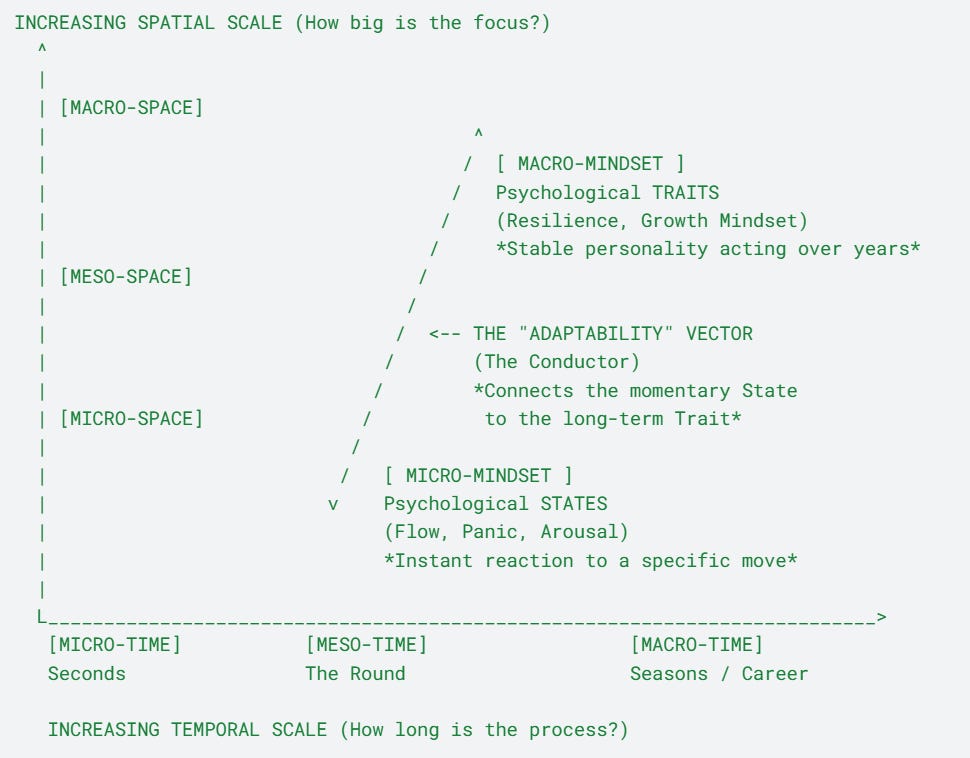
The core problem in climbing performance research is a failure to respect scale (i.e., the appropriate level of observation). More specifically, we fail to recognize that performance exists on a Space-Time Matrix.
We have been using tools and metrics from one scale (the ‘leaf,’ or organism) to predict patterns at another (the ‘forest,’ or competition), and then wondering why our models fail. The ecologist Simon Levin (1992) formalized this as ‘The Problem of Pattern and Scale.’
🌍 What is Levin’s “Problem of Scale”? (In a Nutshell)
The Concept: You cannot understand a forest by studying a single leaf. The “rules” and “patterns” you see in a complex system completely change depending on your “window” of observation.
The Takeaway: The tools and models that explain what’s happening at one scale (like the micro-scale of the forearm) are often useless for predicting what will happen at another scale (like the meso-scale of a single competition round). This inability to link scales is the reason for the “Great Divide.”
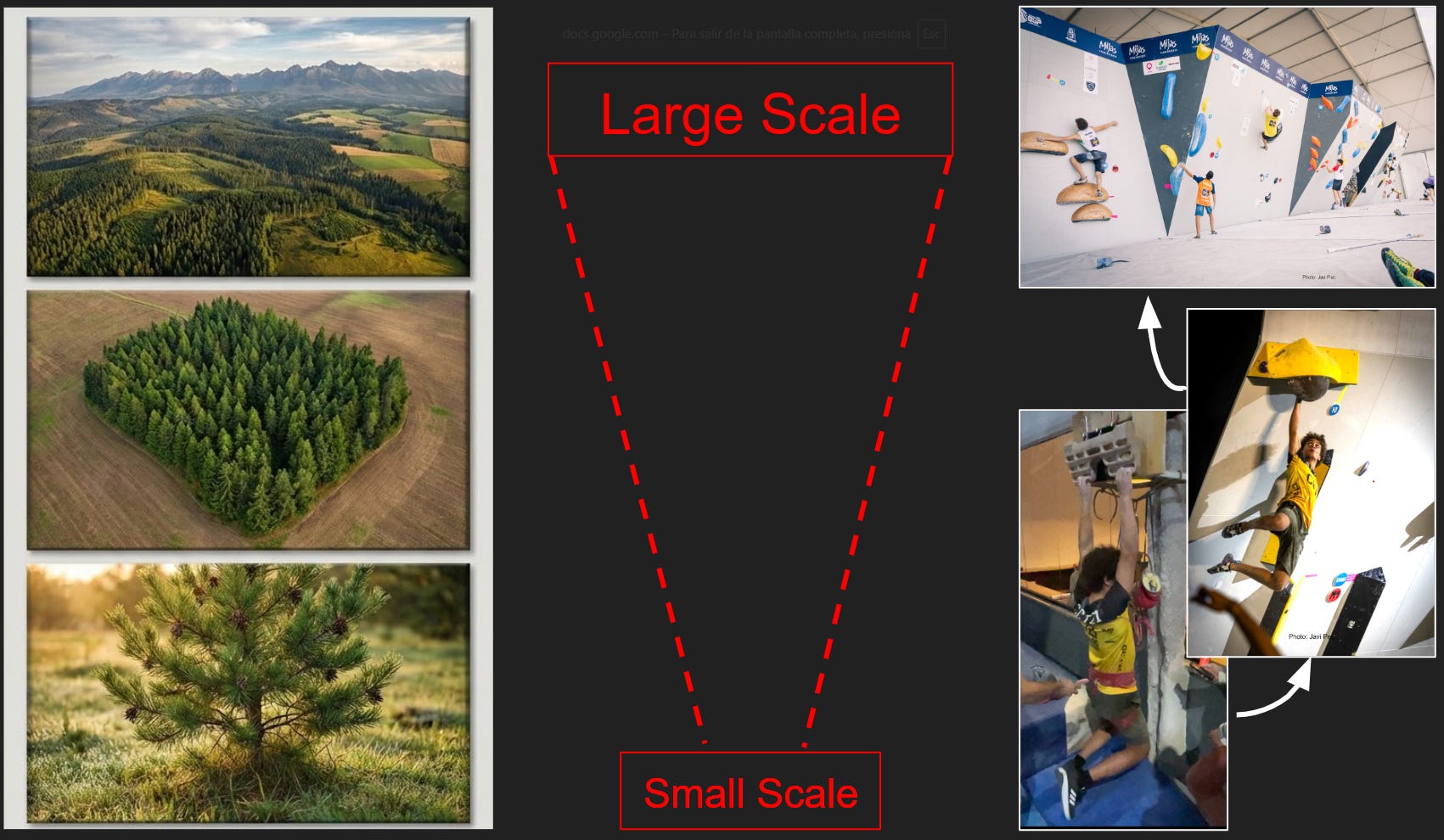
This failure to respect scale leads directly to statistical frustration. Because the chaotic, multi-scale reality (the Habitat) introduces massive inter- and intra-individual variance, researchers relying on traditional Frequentist statistics often struggle to achieve statistical significance. The noise from the Meso-scale overwhelms the signal from the Micro-scale, leading to the misleading conclusion that “no effect” exists.
To capture the full complexity of climbing, we must organize these scales into a Space-Time Matrix. Levin(1992) argued that patterns move along two coupled axes: the Spatial Scale (how big is the focus?) and the Temporal Scale (how long is the window?).
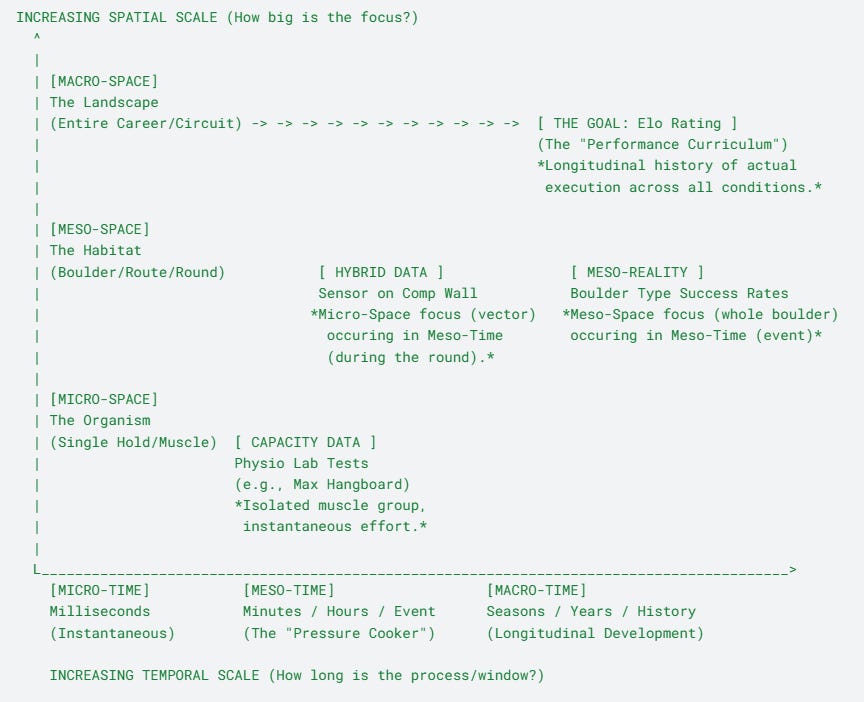
The field’s error is fundamental: researchers take data from the Micro-Coordinate (kg of force on a physio test) and try to predict the Macro-Coordinate (Season Rankings or Career Success), completely ignoring the massive Meso-Coordinate (e.g., the success rate on technical boulders in a competition round) that sits between them.
3. The “HOW”: The Self-Organizing Athlete
So if the “Habitat” (according to Levin, 1992) is the external structure, how does the athlete internally solve it?
The concept that athletes are “self-organizing organisms” came from the influential work of Udo Neumann, whose ecological approach is the practical application of Motor Control Science, whose founding father is Nicolai Bernstein.
🤸 What is “Motor Control Science”? (Bernstein in a Nutshell)
The Concept: Think of your body as a 1,000-piece orchestra. The brain cannot micromanage every muscle. Bernstein called this the “degrees of freedom problem.”
The Takeaway: The brain “self-organizes” by creating “synergies”—functional groups of muscles that act as one. It simplifies an impossibly complex problem into one, functional, adaptive solution.
This process is the mechanism of Adaptability. This mechanism is fractal (Mandelbrot, 1975)—the same principles of adaptive problem-solving apply across scales:
A single boulder problem is like a live, real-time ‘song’ that an athlete must “sight-read” on demand.
In this analogy, the ‘Orchestra’ is the synthesis of the athlete’s physiological capacity and their stylistic ability. Just as an orchestra is a collection of instruments that must be played at the right intensity, the climber possesses a set of physical instruments (strength, endurance, flexibility) that must be applied to specific climbing styles (physical, technical, coordination).
Their ‘Adaptability’, then, is their ‘conductor’s’ skill—the real-time ability to lead that orchestra to successfully perform that new ‘song’ (the ‘problem’) on the fly.
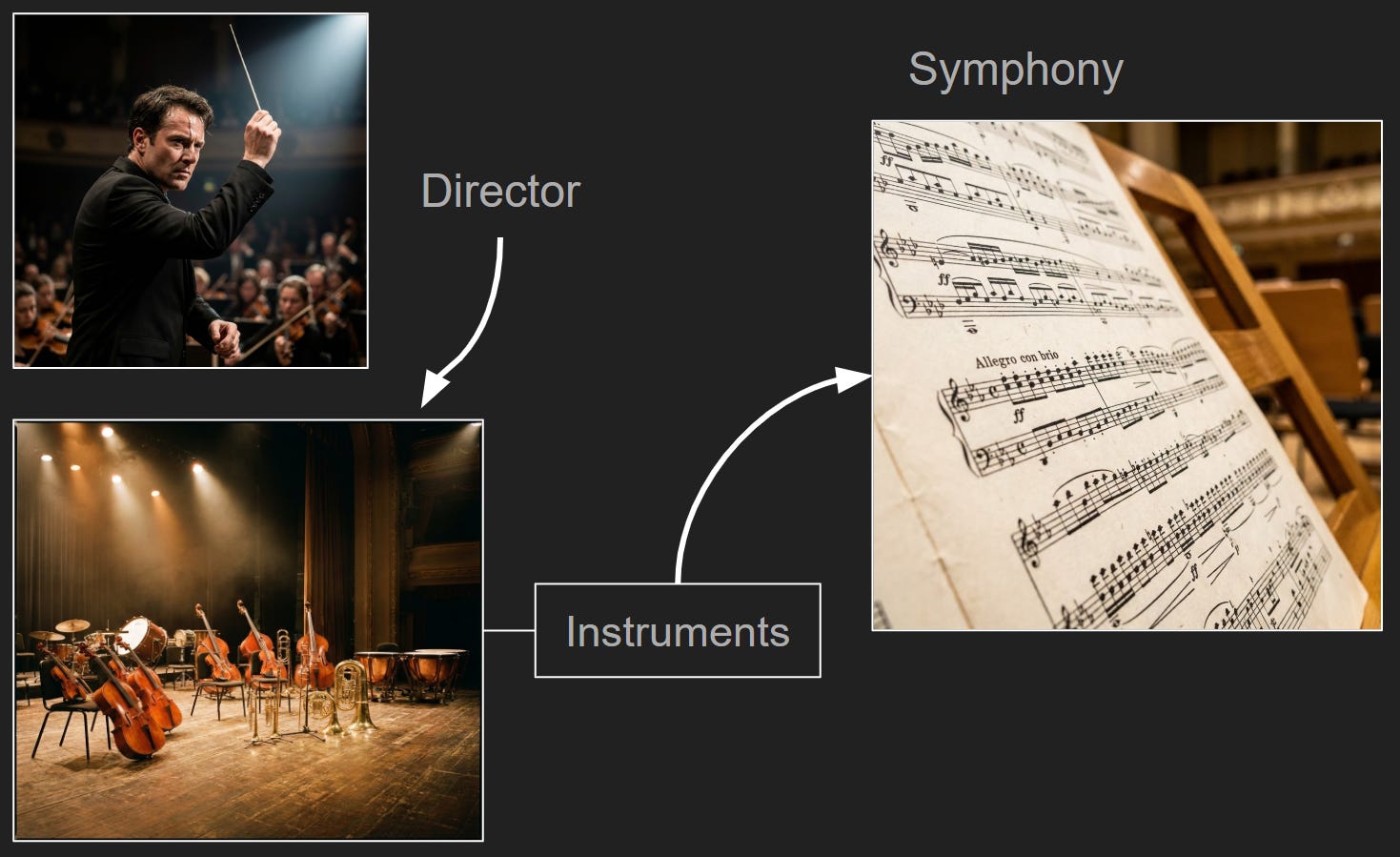
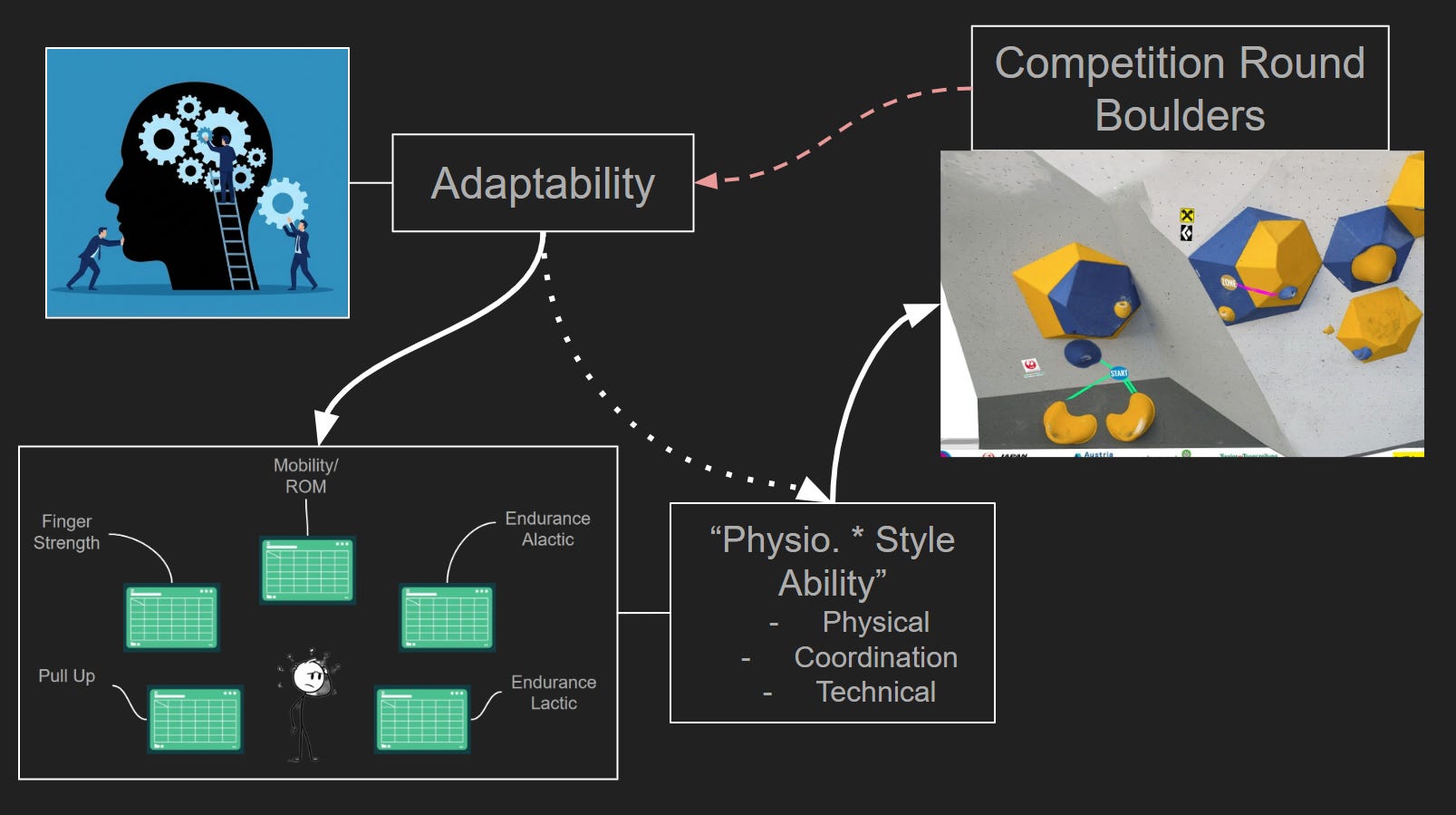
This “adaptation” is the mechanism inside our “black box.” And this process is fractal—it happens at every scale simultaneously: the athlete “adapts” to the move (physical), the boulder (tactical), and the round (psychological).
4. The Unified Model: Internal Components vs. External Pressures
We can now merge these two theories into a single, robust framework. Performance is the interaction between the athlete’s Internal Components and the “Habitat’s” External Pressures.
The Habitat acts as a Filter, and the athlete’s Adaptability is the Modifier that determines how successfully they pass through it.
The Athlete’s Three Internal Components
Physiology (The “Engine”): The raw physical capacity (P).
Stylistic Toolbox (The “Generalist Hardware”): The specialist-generalist trade-off (R).
Example: A Generalist species (like the American Crow) has a broad “Stylistic Toolbox,” thriving across the variable ‘Landscape.’ A Specialist (like the Northern Spotted Owl) requires a narrow niche and fails when the ‘Habitat’ changes. The unstable competition landscape inherently selects for the Generalist.Adaptability (The “Behavioral Plasticity”): The purely internal, psychological/behavioral trait (A). This is the conductor’s skill: the ability to manage stress and deploy the right tool from their toolbox.
Importantly, Adaptability is the only component that operates fluidly across both dimensions of the Space-Time Matrix. It unifies the scales (Spielberger, 1966; Lazarus & Folkman, 1984).
The “Habitat’s” Three External Pressures
These are the “selective filters” of the CompetitionID that test the athlete’s internal components:
The Routesetting (”Habitat Complexity”): This is the objective puzzle (the abiotic structure) that tests the breadth of the Stylistic Toolbox and the problem-solving of Adaptability.
The Community (”Predator Pressure”): This is the biotic stress (the clock, the crowd, the competitors). This pressure directly attacks the athlete’s Adaptability.
The Environment (”Abiotic Filter”): This is the temperature, humidity, etc. This is a hard physiological filter that tests the athlete’s Physiology.
5. Conclusion: The “Behaviorally Plastic Generalist”
The “Great Divide” is solved. The ‘Rock Climber’ (Capacity) is an athlete optimized for a controlled Meso-scale reality. They manipulate the ‘Habitat’ variables—choosing the best weather, the perfect rest, and the route that fits their style—to maximize their success. Research often overlooks this multi-scale reality, treating the grade as a simple physiological output.
The “Competition Climber” (Execution) is something far more complex: a “Behaviorally Plastic Generalist.”
The Execution Score is defined by their Base Potential modified by their Adaptability Factor:

This final conceptual formula is validated by empirical evidence:
A Choker (whose high Base Potential predicts a podium finish) suffers a negative Adaptability Modifier, resulting in a lower rank (e.g., 6th place).
A Booster (medium Base Potential, high positive Adaptability Modifier) achieves podium success by performing above their expected potential.
This new framework provides a common language for coaches, athletes, and researchers. It allows us to finally stop measuring what is easy and start modeling what is important. For a coach, this means training Adaptability not as a bonus, but as a fundamental, trainable skill alongside strength and technique.
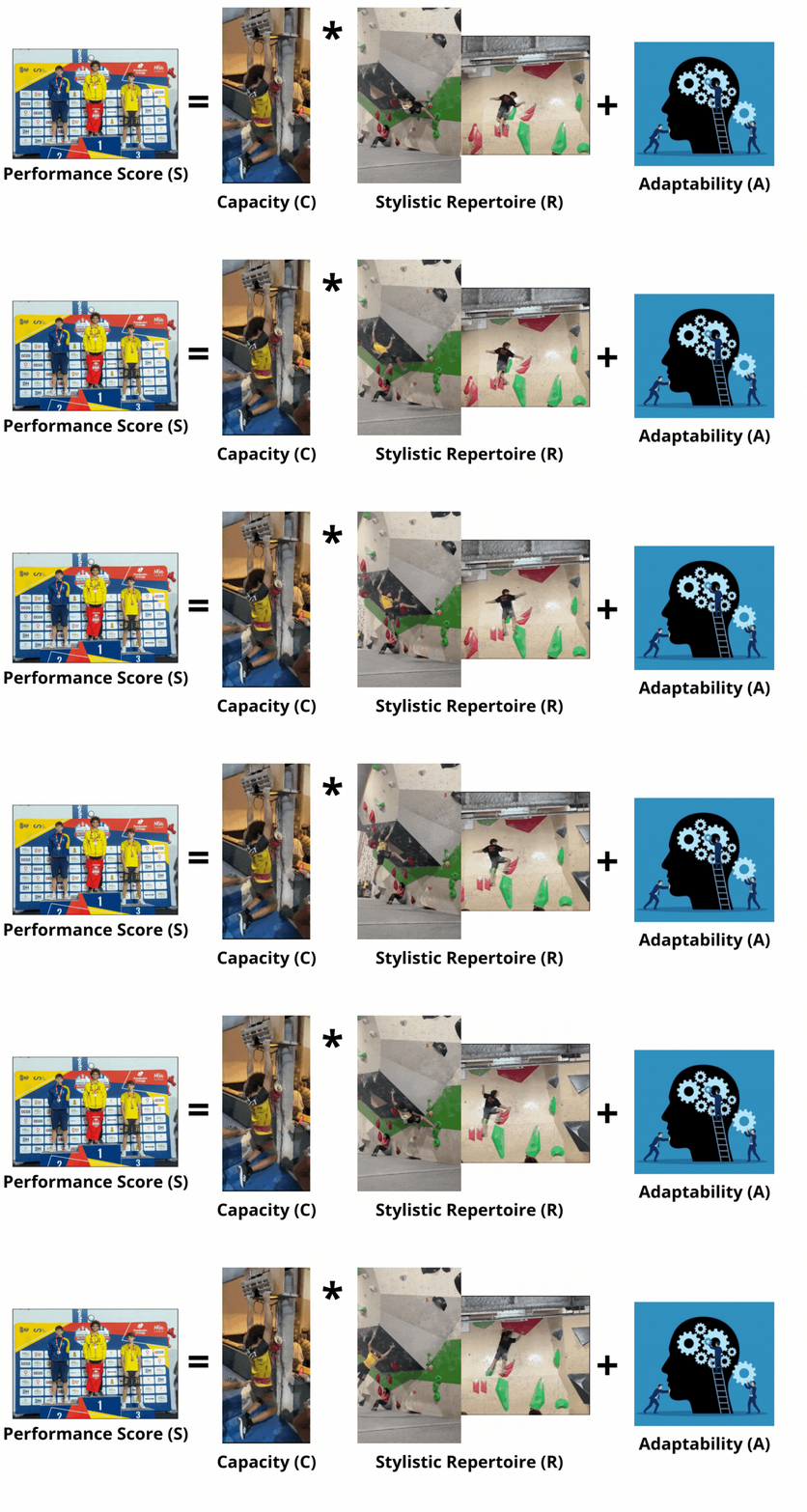
Competitive success (The Podium) is not a simple result of physical capacity. It is the product of Physiology (P) multiplied by Stylistic Repertoire (R), all governed by the Adaptability Modifier (A)—the internal conductor that determines if that potential is actually delivered on the day.
Foundational Research
Bernstein, N. (1967). The Co-ordination and Regulation of Movements. Pergamon-Press, Oxford.
Holland, J. H. (1992). Complex adaptive systems. Daedalus, 121(1), 17-30.
Lazarus, R. S., & Folkman, S. (1984). Stress, Appraisal, and Coping. Springer.
Levin, S. A. (1992). The Problem of Pattern and Scale in Ecology: The Robert H. MacArthur Award Lecture. Ecology, 73(6), 1943-1967.
Mandelbrot, B. B. (1975). Les objets fractals: forme, hasard et dimension. Flammarion.
Mitchell, M. (2009). Complexity: A Guided Tour. Oxford University Press.
Spielberger, C. D. (1966). Theory and research on anxiety. Academic Press.